STAR Stories - Innovation Archetypes
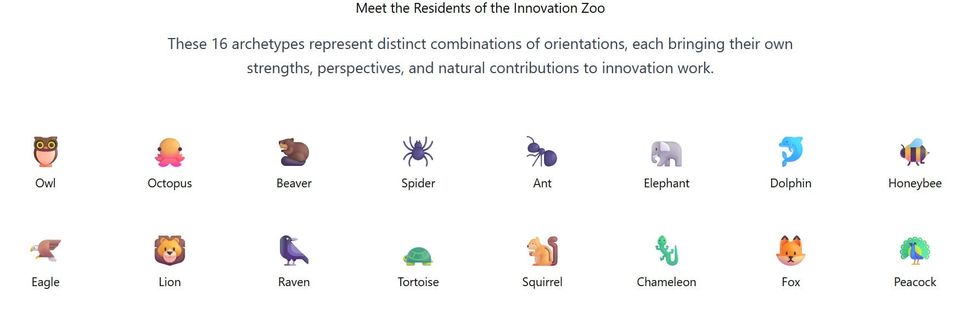
he sources provide specific STAR (Situation, Task, Action, Result) examples for all 16 Innovation Archetypes, demonstrating how each character creates unique value in the innovation ecosystem. Here are the STAR stories for each character, grouped by their Innovation Orientation: Learning-Oriented Archetypes 📚
Archetype | Situation | Task | Action | Result |
Curious (Owl) 🦉 | A healthcare startup was considering implementing blockchain technology for patient records, but the team lacked understanding of the technology's implications. | Research blockchain applications in healthcare to inform the team's decision-making process. | Spent three weeks attending blockchain meetups, reading 20 research papers, interviewing five healthcare blockchain experts, joining two online communities, and testing three existing healthcare blockchain platforms. | Presented a comprehensive briefing that identified key technical hurdles and regulatory challenges, leading the team to partner with an existing blockchain platform rather than building from scratch, saving an estimated $200K in development costs. |
Cataloguer (Octopus) 🐙 | A technology company had accumulated five years of innovation experiments, and valuable learnings were scattered across different teams and systems. | Create a knowledge management system that would preserve learnings and make them accessible for future innovation work. | Interviewed team members to understand current knowledge storage practices, designed a searchable knowledge base with standardized templates, migrated historical project documentation, and created processes for ongoing knowledge capture. | The knowledge base reduced time spent on redundant research by 40%, helped teams avoid repeating past mistakes, and became a key resource for onboarding new innovation team members, with 90% of users rating it as valuable for their work. |
Action-Oriented Archetypes 🔨
Archetype | Situation | Task | Action | Result |
Catalyst (Beaver) 🦫 | A product development team had been stuck for three weeks on a complex integration problem that was blocking their entire sprint. | Help the team break through the technical and communication barriers preventing progress. | Facilitated a half-day problem-solving session, suggested they break the integration into smaller, testable components, helped team members clearly articulate the specific issues, and connected them with an external expert who had solved similar problems. | The team solved the integration problem within four days, delivered their sprint goals on time, and adopted the component-based approach for future integrations, reducing average integration time by 40%. |
Creator (Spider) 🕷️ | A sustainability-focused startup needed to prove their carbon tracking concept could work at scale before seeking Series A funding. | Build a working prototype that could demonstrate the core technology with real data. | Developed a minimal viable product over six weeks, integrated it with three different IoT sensor platforms, created a real-time dashboard, and tested it with five pilot customers to gather usage data and feedback. | The working prototype helped secure $2M in Series A funding and attracted partnerships with two major manufacturing companies who wanted to pilot the solution. |
Contractor (Ant) 🐜 | An innovation lab was struggling to turn promising prototypes into scalable implementations due to lack of operational structure. | Create project management processes that could handle the complexity of innovation work while maintaining flexibility. | Developed agile project management frameworks adapted for innovation uncertainty, created standardized documentation templates, implemented progress tracking systems, and trained team leads on innovation project management best practices. | Project completion rates increased from 60% to 85%, average time from prototype to pilot decreased by 35%, and the lab successfully scaled three innovations to full product launches within one year. |
Support-Oriented Archetypes 🤝
Archetype | Situation | Task | Action | Result |
Coach (Elephant) 🐘 | A rapidly growing startup needed to onboard 15 new engineers quickly while maintaining code quality and team culture. | Design and implement an onboarding program that would get new engineers productive quickly. | Created a structured 30-day learning path, established peer mentoring pairs, developed hands-on coding exercises using real project examples, and implemented weekly check-ins to track progress and address obstacles. | New engineer time-to-productivity decreased from 8 weeks to 4 weeks, code quality metrics remained stable despite rapid growth, and employee satisfaction scores for onboarding experience increased by 35%. |
Cheerleader (Dolphin) 🐬 | A development team was demoralized after a major product launch failed to meet user adoption targets, leading to low energy and decreased collaboration. | Restore team morale and motivation while learning from the setback. | Organized a "failure celebration" event to acknowledge lessons learned, created a team recognition program highlighting individual contributions during the difficult period, shared stories from other companies that had bounced back from similar setbacks, and established weekly "wins" sharing sessions. | Team engagement scores increased from 4.1 to 7.8 out of 10, collaboration improved as measured by code review participation and cross-team projects, and the team's next product launch exceeded adoption targets by 40%. |
Connector (Honeybee) 🐝 | A fintech startup needed partnerships with traditional banks but had no existing relationships in the banking industry. | Build relationships between the startup team and potential banking partners. | Leveraged a personal network to identify decision-makers at six target banks, organized informal meetups between startup founders and bank innovation teams, facilitated introductions at three industry conferences, and created ongoing communication channels between technical teams. | Two partnership agreements were signed within four months, leading to pilot programs that generated $300K in revenue and provided validation for expanding into the enterprise banking market. |
Strategic-Oriented Archetypes 🎯
Archetype | Situation | Task | Action | Result |
Captain (Eagle) 🦅 | A cross-functional innovation team was struggling with competing priorities, unclear decision-making authority, and misaligned stakeholder expectations. | Establish clear leadership structure and align team efforts toward measurable outcomes. | Conducted stakeholder interviews to understand competing priorities, established weekly leadership meetings with clear decision-making protocols, created shared KPIs that balanced innovation goals with business metrics, and implemented bi-weekly stakeholder updates. | Team delivery speed increased by 60%, stakeholder satisfaction scores improved from 6.2 to 8.7 out of 10, and the team successfully launched three major features that generated $500K in new revenue. |
Champion (Lion) 🦁 | An AI development project was facing internal resistance due to concerns about algorithmic bias and fairness. | Build organizational support for implementing responsible AI development practices. | Created compelling presentations showing the business and ethical risks of biased AI, rallied support from diverse stakeholders including legal and HR teams, organized workshops on inclusive AI design, and lobbied executives for dedicated bias-testing resources. | Secured $150K budget for responsible AI framework development, which became the company standard and helped win three major client contracts that specifically required ethical AI practices. |
Contrarian (Raven) 🐦⬛ | An e-commerce company was planning to invest $1M in a new recommendation engine based on promising initial test results. | Ensure the investment decision was based on comprehensive analysis of potential risks and limitations. | Researched cases where similar recommendation engines had failed, identified potential biases in the initial test data, analyzed competitive responses that could reduce effectiveness, and modeled scenarios where user behavior changes could impact performance. | Analysis revealed significant risks related to data privacy regulations and competitor responses, leading to a revised implementation plan that included privacy-by-design features and competitive moats, ultimately saving an estimated $400K in compliance and competitive response costs. |
Conscience Keeper (Tortoise) 🐢 | A social media platform was developing new features to increase user engagement but faced concerns about potential negative impacts on mental health. | Ensure the platform's growth strategy considered long-term user wellbeing and societal impact. | Conducted research on social media’s mental health impacts, consulted with child psychologists and digital wellness experts, developed ethical design principles, and created user wellbeing metrics to track alongside engagement metrics. | The ethical framework became a key differentiator in B2B sales, helped secure partnerships with educational institutions concerned about student wellbeing, and contributed to 25% lower user churn rates compared to industry averages. |
Growth-Oriented Archetypes 📈
Archetype | Situation | Task | Action | Result |
Capital Investor (Squirrel) 🐿️ | A promising AI startup had impressive technology demos but an unclear path to profitability, making it difficult to secure Series B funding. | Develop a sustainable business model that would attract investors and customers. | Analyzed competitive pricing models, calculated customer acquisition costs and lifetime value across different segments, identified the most profitable use cases, created a tiered pricing strategy, and developed financial projections for three growth scenarios. | The refined business model helped secure $5M in Series B funding and increased average customer contract value by 180%, creating a clear path to profitability within 18 months. |
Careerseeker (Chameleon) 🦎 | A marketing professional wanted to transition into product management but lacked direct experience in the field. | Gain relevant product management experience while contributing value to current innovation projects. | Volunteered to manage user research for three innovation initiatives, learned product management frameworks through online courses, networked with product managers to understand their daily work, and documented learnings through a professional blog. | Successfully transitioned to a product manager role within eight months, with the blog serving as a portfolio that demonstrated both learning ability and product thinking, leading to a 30% salary increase. |
Consultant (Fox) 🦊 | A healthcare system wanted to implement AI-powered diagnostic tools but lacked internal expertise to evaluate different vendor solutions. | Provide independent analysis and recommendations for AI diagnostic platform selection. | Quickly learned healthcare AI regulatory requirements, evaluated five vendor platforms against clinical workflow requirements, interviewed radiologists about usability needs, and conducted a cost-benefit analysis for different implementation approaches. | The recommended solution was implemented successfully, improving diagnostic accuracy by 15% while reducing radiologist workload by 20%, and the client engaged the consultant for two additional AI implementation projects. |
Content Influencer (Peacock) 🦚 | A clean technology startup had developed innovative solar panel technology but struggled to gain visibility in a crowded market. | Build market awareness and thought leadership for the company's innovation story. | Created a compelling content strategy highlighting the technology's unique benefits, developed case studies showcasing customer success stories, built a social media presence focused on clean energy innovation trends, and spoke at industry conferences. | Content efforts generated a 200% increase in qualified sales leads, the CEO was invited to speak at three major industry conferences, and the company was featured in prominent trade publications, ultimately contributing to a successful $10M funding round. |
--——————————————————————————Analogy for Understanding STAR The STAR method serves as a GPS for communicating value. Instead of vaguely stating "I am a Champion," a STAR story provides the map (Situation), the destination (Task), the vehicle and route taken (Action), and the arrival point with specific mileage calculated (Result). This moves the description of the archetype from an abstract personality trait to a concrete professional capability.